
Audio Presentation
Abstract
Immersive virtual reality (VR), which enables users to interact with digital 3D worlds through head-mounted displays (HMDs), has emerged as a promising tool for supporting management of acute pain in both procedural and non-procedural contexts. Although growing evidence suggests that VR as an overall modality can be effective in mitigating acute pain, the distinction between gamified and passive VR interventions, and the potential implications for pain-related outcomes, remains unclear. This scoping review explores the use, components, trends, and potential benefits of gamified VR for acute pain compared with standard care and passive VR. A systematic search of PubMed, Scopus, Embase, and CENTRAL, supplemented by manual citation review, identified eligible primary studies of immersive gamified VR for pediatric or adult patients with acute pain. Twenty-six articles published between March 2005 to November 2023 were included, comprising 1,390 participants across 17 pediatric and 9 adult studies. Most studies addressed procedural pain. Gamified VR was associated with improvement in at least one primary outcome versus non-VR comparators in 19 of 23 studies, with statistically significant findings in 14. Relative to passive VR, benefits were reported in 3 of 7 studies. Common gameplay mechanics included aiming, racing, dodging, puzzle-solving, and rhythm-based tasks. Overall, gamified VR shows promise as an adjunctive strategy for acute pain management, particularly for pain, anxiety, medication use, and patient satisfaction. Study limitations include heterogeneity across study designs, comparators, and intervention features. Future research directions include exploring specific design elements that optimize efficacy across clinical settings.
Introduction
Acute pain affects millions yearly, with both procedural (medical operations) & non-procedural (injury) causes.[1] Immersive virtual reality (VR) – which enables interaction with digital 3D worlds via head-mounted displays (HMDs) – has emerged as a promising non-pharmacological alternative/adjuvant tool for potential pain mitigation, due to its low cost, programmability, and availability.[2] The implementation of VR has varied widely across the literature, ranging from passive immersion to highly interactive games. This heterogeneity is important to note because VR games may offer greater levels of engagement than passive VR. Gamified VR is a distinct subset of VR interventions involving enhanced interactivity, goals, and dynamic feedback, which promotes psychological "flow" (associated with immersion, distraction, and enjoyment).[3] This modality offers the potential to produce more engaging patient experiences than passive VR, which in comparison typically lacks these features and instead centers around static user immersion. To assess the current state of the literature and inform future VR interventions, this scoping review of gamified VR in acute pain aims to summarize its use, components, thematic trends, and possible benefits compared to standard care as well as passive VR interventions.
Materials & Methods
A systematic literature search was conducted across four databases (PubMed, Scopus, Embase, CENTRAL) and supplemented by manual citation review, in accordance with the Arksey-O’Malley scoping review framework.[4] A Boolean search strategy was used, incorporating a variety of keywords and subject headings relating to pain/VR/gaming. Eligible studies featured (1) primary peer-reviewed research (conference papers included), (2) adult or pediatric patients undergoing medical procedures or diagnosed with acute pain conditions based on ICD-10 criteria, (3) pain-related primary outcomes, (4) use of an HMD to deliver immersive VR, and (5) gamified VR interventions (defined as having in-game objectives along with interactivity beyond passive 360° viewing). Given that VR gaming for pain management is an emerging topic, both experimental and observational studies were considered. Screening was performed on Rayyan, eligible articles exported to Zotero, and extracted data synthesized in tabular form.
Results
The search strategy yielded 1027 records. After screening for exclusion/inclusion criteria, 26 articles (ranging from 03/2005-11/2023) were deemed eligible and included for analysis, spanning 17 pediatric (897 patients) and 9 adult (493 patients) studies. Of these, 22 involved acute procedural pain and 4 involved acute non-procedural pain. Relevant outcomes evaluated were pain intensity (24 studies), patient satisfaction with the VR intervention(s) (19), anxiety/fear (14), opioid/medication use (7), vitals (6), procedural duration (5), and functional improvement (1). Gamified VR was reported to provide greater improvements in at least one primary outcome relative to non-VR comparators (e.g. standard care, music, talking) in 19/23 studies (statistically significant in 14/19), and relative to non-gamified VR in 3/7 studies (statistically significant in 1/5). Also, five categories of game mechanics were identified: aiming (17 studies), racing (4), dodging (3), puzzle (3), and rhythm (2). (Figure 1)
Conclusions
Studies suggest gamified VR may be an effective analgesic intervention, as indicated by pain scores and high satisfaction, across both pediatric and adult patients experiencing procedural or non-procedural acute pain. Anxiolytic effects (in 10 studies) and reduced medication use (in 6 studies) were also observed. Furthermore, the identification of gameplay themes sheds light on consistent components that may affect efficacy. This scoping review thus offers novel insights that could help inform design and optimization of VR interventions. Some study limitations include: the heterogeneity of comparators across and within reviewed articles, exclusion of non-immersive gaming, and lack of conclusion regarding overall efficacy of gamified VR versus passive VR given that a meta-analysis was not performed. Future studies should add a large-scale evaluation on the impact of different VR design elements on therapeutic efficacy, as well as analysis of VR gaming in other contexts, such as chronic pain.
Figures
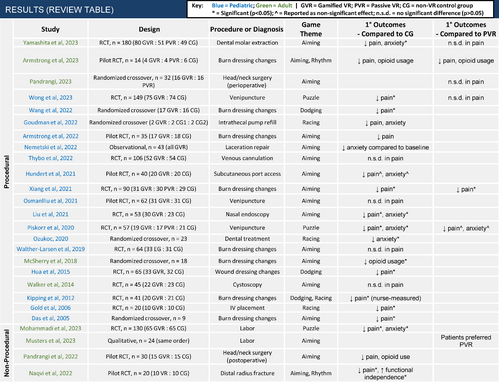
Figure 1. Review table summarizing the results of the literature search and analysis.
Figure 1. Review table summarizing the results of the literature search and analysis.
References
[1] Zaslansky, R., Rothaug, J., Chapman, C., Backström, R., Brill, S., Fletcher, D., Fodor, L., Gordon, D., Komann, M., Konrad, C., Leykin, Y., Pogatski-Zahn, E., Puig, M., Rawal, N., Ullrich, K., Volk, T., & Meissner, W. (2015). PAIN OUT: The making of an international acute pain registry. European Journal of Pain, 19. https://doi.org/10.1002/ejp.571.
[2] Jain, S., Armstrong, M., Luna, J., Thakkar, R. K., Fabia, R., Groner, J. I., Noffsinger, D., Ni, A., Nelson, E., & Xiang, H. (2024). Features of virtual reality impact effectiveness of VR pain alleviation therapeutics in pediatric burn patients: A randomized clinical trial. PLOS Digital Health, 3(1), e0000440. https://doi.org/10.1371/journal.pdig.0000440
[3] Caserman, P., Hoffmann, K., Müller, P., Schaub, M., Straßburg, K., Wiemeyer, J., Bruder, R., & Göbel, S. (2020). Quality Criteria for Serious Games: Serious Part, Game Part, and Balance. JMIR Serious Games, 8(3), e19037. https://doi.org/10.2196/19037
[4] Arksey, H., & O’Malley, L. (2005). Scoping studies: Towards a methodological framework. International Journal of Social Research Methodology, 8(1), 19–32. https://doi.org/10.1080/1364557032000119616
[2] Jain, S., Armstrong, M., Luna, J., Thakkar, R. K., Fabia, R., Groner, J. I., Noffsinger, D., Ni, A., Nelson, E., & Xiang, H. (2024). Features of virtual reality impact effectiveness of VR pain alleviation therapeutics in pediatric burn patients: A randomized clinical trial. PLOS Digital Health, 3(1), e0000440. https://doi.org/10.1371/journal.pdig.0000440
[3] Caserman, P., Hoffmann, K., Müller, P., Schaub, M., Straßburg, K., Wiemeyer, J., Bruder, R., & Göbel, S. (2020). Quality Criteria for Serious Games: Serious Part, Game Part, and Balance. JMIR Serious Games, 8(3), e19037. https://doi.org/10.2196/19037
[4] Arksey, H., & O’Malley, L. (2005). Scoping studies: Towards a methodological framework. International Journal of Social Research Methodology, 8(1), 19–32. https://doi.org/10.1080/1364557032000119616
Conflicts of Interest
The authors do not have any conflicts of interest.
Funding Statement
Departmentally funded.