
Abstract
The existence of the disease leads us to the search for healing. According to Bert Hellinger. Chronic pain has family and social repercussions. The importance of involving the family system in the multidisciplinary approach to patients with chronic pain can improve the patient's acceptance of their illness. The NCF in a therapeutic model allows the integration of transgenerational memories in a morphic information field, which, modifying it by the hologramic capacity of words as seeds of new events, generates a new look at pain.
BACKGROUND
they relate the relevance of the family environment in pain management; the family could unconsciously be responsible for maintaining and perpetuating the patient's pain problems and could play a role as an agent of positive coping of the patient towards pain. A doctoral study, NCF Therapy is designed to detect changes in certain cognitive parameters, such as self-concept and acceptance, sense of coherence.
AIM
Identify through NCF therapy the premises about chronic pain in the patient, its systemic implication and the modification of the acceptance relationship with chronic pain.
BACKGROUND
they relate the relevance of the family environment in pain management; the family could unconsciously be responsible for maintaining and perpetuating the patient's pain problems and could play a role as an agent of positive coping of the patient towards pain. A doctoral study, NCF Therapy is designed to detect changes in certain cognitive parameters, such as self-concept and acceptance, sense of coherence.
AIM
Identify through NCF therapy the premises about chronic pain in the patient, its systemic implication and the modification of the acceptance relationship with chronic pain.
Materials & Methods
It is developed with the patient in individual therapy, prior to completing the DME questionnaire detecting emotional distress. The therapy establishes the morphogenetic field where the work will be done, then the topic is explained to the patient, starting with the current Self, then the chronic pain, and finally the acceptance of the disease.
Through systemic steps (helpful element: a sheet with the written word to work in the constellation). The patient places the footprints within the field, stands behind each one, starting with the current Self, focuses and then standing on the footprint, feels through a state of phenomenology of perception and observes what happens(feels what). that your body feels) then describe the sensations at the site of each of those footsteps. Through a first reading of the composition of the space and body language, the therapist has elements to know what is involved and by asking his guide he establishes the movements and through healing phrases generates the grammar within the field, directing the process until a moment where the patient feels that their situation with respect to the disease improved or changed towards the positive. The constellations “reflect” an emotional reality of the patient in a graphic and comprehensive way and through the constellation movement and balance phrases that modify the field to a new reality. After therapy, 30 days later, the patient fills out the DME questionnaire and changes in the score are evaluated.
Through systemic steps (helpful element: a sheet with the written word to work in the constellation). The patient places the footprints within the field, stands behind each one, starting with the current Self, focuses and then standing on the footprint, feels through a state of phenomenology of perception and observes what happens(feels what). that your body feels) then describe the sensations at the site of each of those footsteps. Through a first reading of the composition of the space and body language, the therapist has elements to know what is involved and by asking his guide he establishes the movements and through healing phrases generates the grammar within the field, directing the process until a moment where the patient feels that their situation with respect to the disease improved or changed towards the positive. The constellations “reflect” an emotional reality of the patient in a graphic and comprehensive way and through the constellation movement and balance phrases that modify the field to a new reality. After therapy, 30 days later, the patient fills out the DME questionnaire and changes in the score are evaluated.
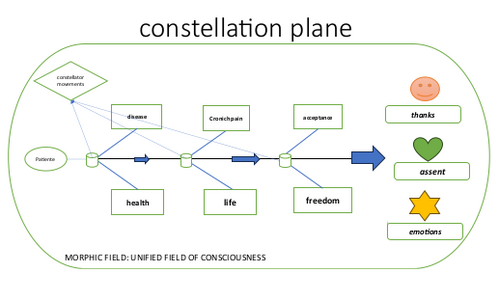
NCF therapy focused on the acceptance of chronic pain was carried out following the protocol described above in ten patients who presented pathologies with defined secondary associated chronic pain and who had undergone medical, pharmacological and therapeutic management and as complementary help to their disease they decided to accept the therapy.
Results
Results study with a population of 10 patients, 7 women, 3 men, ages between 42 and 86 years, with an average age of 56.7 chronic pain pathology secondary to: Cancer 3, low back pain: 3 fibromyalgia:4.
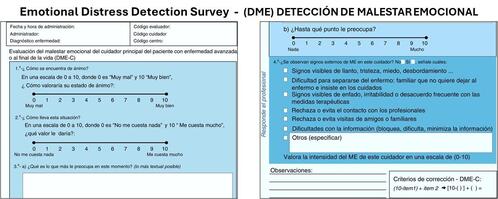
Patients have a mean emotional distress DME score of 12.2 (8-18), with approximately half of patients having scores >10. DME established that 60% of patients presented moderate to intense emotional distress. In the control questionnaire, the average DME score was less than 10 at 8.4, decreasing from mild to moderate in cases such as fibromyalgia, it decreased by 50%, in lumbar pathology the scores decreased only in two of the three patients. in the pathology of pain associated with cancer decreased after NCF therapy.
Conclusions
Through the TNCF it is evident that emotional discomfort, acceptance of the disease and chronic pain are linked.
The DME emotional scale helps us identify how TNCF allows the patient to give a new perspective to their illness.
Through this study, only one specific element of the multiple elements that TNCF develop, balance and compensate in the relationship with illness and chronic pain is reviewed.
The TNCF helps define a new controlled representation of the pain situation. It opens the possibility of distancing oneself from the traumatic situation through observation, the provision of emotional resources, the construction of healing images, the participation of the whole body in the transformation process, the gradual release of physical and emotional obstructions and entering in the field of repair of their family system through transgenerational memories.
The DME emotional scale helps us identify how TNCF allows the patient to give a new perspective to their illness.
Through this study, only one specific element of the multiple elements that TNCF develop, balance and compensate in the relationship with illness and chronic pain is reviewed.
The TNCF helps define a new controlled representation of the pain situation. It opens the possibility of distancing oneself from the traumatic situation through observation, the provision of emotional resources, the construction of healing images, the participation of the whole body in the transformation process, the gradual release of physical and emotional obstructions and entering in the field of repair of their family system through transgenerational memories.
REFERENCES
- Peñarieta Acosta, Maria Fernanda Free topic in psychotherapy Family constellations; heal from the family soul Scientific Journal Medical Science, vol. 8, no. 1, November, 2005, pp. 48-49 Universidad Mayor de San Simón Cochabamba, Bolivia
- Yolanda Alonso International Journal of Psychology and Psychological Therapy 2005, Vol. 5, No. 1, pp. 85-96 Bert Hellinger's family constellations: a psychotherapeutic procedure in search of identity * University of Almería, Spain
- Joaquín T. Limoneroa,∗, Dolors Mateob, Evaluation of the psychometric properties of the Emotional Distress Detection Questionnaire (DME) in oncological patients Gaceta Sanitaria Volume 26, Number 2, March-April 2012, pages 145-152
- Rev Soc Esp Dolor 2014; 21(1): 1-2 Chronic pain, more than just a problem for those who suffer from it
- Ilse kutchera, disease that heals, pathological symptoms and family constellations editorial Alma lepik 2002
- De Souza L, Frank AO. Patients’ experiences of the impact of chronic back pain on family life and work. Disabil Rehabil 2011;33(4):310-8.
- Lewandowski W, Morris R, Draucker CB, Risko J. Chronic pain and the family: Theory-driven treatment 2007;28(9):1019-44
Relevance to patient care
This is an inclusive study of the patient's emotions and feelings and pain. Which involves how transgenerational therapy helps this integration.
Conflicts of Interest
The author declares that there are no conflicts of interest related to the publication of this article.
Funding Statement
The research did not receive specific funding.