Abstract
BACKGROUND
Breast cancer is the most common cancer in the world and a leading cause of cancer death in females worldwide. Patients with hormone positive Breast Cancer are at risk of recurrence after treatment. To assist in limiting this risk, patients are prescribed an Aromatase Inhibitor for a recommended 5 to 10 years. These medications are a class of hormonal agent that block the enzyme that helps the body produce estrogens, preventing recurrence by up to 65%.
A pain syndrome called Aromatase Inhibitor-Associated Musculoskeletal Syndrome (AIMSS) develops in up to 46% of women who take these drugs leading to early discontinuation in many patients. The cause of this syndrome is unknown, and there is no established treatment. . Patients report that symptoms peak approximately 6 months after the first dose.
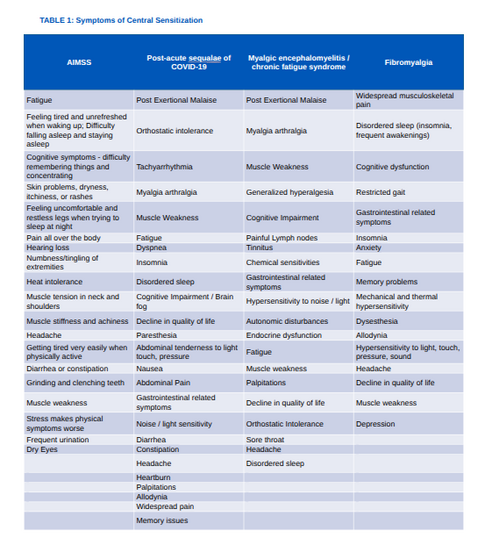
Central Sensitization has been posited as an etiological factor. Central Sensitization involves an increase in the excitability of the neurons within the Central Nervous System that results in heightened sensitivities for patients with chronic symptoms. These heightened sensitivities result in an abnormal enhancement of pain from painful stimuli (hyperalgesia) and from non-painful stimuli (allodynia). Table 1 contains prominent symptoms of central sensitization across common disorders thought to be caused by these central nervous system changes.
The present study compared breast cancer survivors with Aromatase Inhibitor Musculoskeletal Syndrome to patients diagnosed with Fibromyalgia, a well-documented centrally mediated pain syndrome, on measures of Central Sensitization and psychological distress.
METHODS
Thirty-two consecutive female breast cancer patients diagnosed with Aromatase Inhibitor-Associated Musculoskeletal Syndrome and 164 consecutive female patients diagnosed with Fibromyalgia at a large tertiary medical center participated in the study. The two groups were compared on the Central Sensitization Inventory, Center for Epidemiological Studies-Depression scale, Functional Impact Questionnaire, and the Pain Catastrophizing Questionnaire.
RESULTS
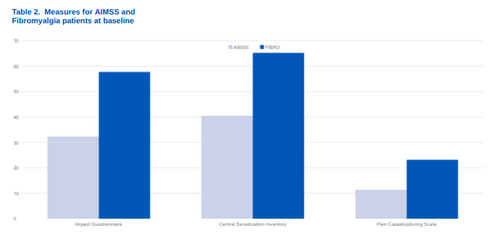
Scores were significantly elevated for both groups on measures of central sensitization. Significant differences were observed between the two groups on measures of functioning, depression, and pain catastrophizing with patients in the Fibromyalgia group appeared significantly more distressed than patients with Aromatase Inhibitor-Associated Musculoskeletal Syndrome.
Breast cancer is the most common cancer in the world and a leading cause of cancer death in females worldwide. Patients with hormone positive Breast Cancer are at risk of recurrence after treatment. To assist in limiting this risk, patients are prescribed an Aromatase Inhibitor for a recommended 5 to 10 years. These medications are a class of hormonal agent that block the enzyme that helps the body produce estrogens, preventing recurrence by up to 65%.
A pain syndrome called Aromatase Inhibitor-Associated Musculoskeletal Syndrome (AIMSS) develops in up to 46% of women who take these drugs leading to early discontinuation in many patients. The cause of this syndrome is unknown, and there is no established treatment. . Patients report that symptoms peak approximately 6 months after the first dose.
Central Sensitization has been posited as an etiological factor. Central Sensitization involves an increase in the excitability of the neurons within the Central Nervous System that results in heightened sensitivities for patients with chronic symptoms. These heightened sensitivities result in an abnormal enhancement of pain from painful stimuli (hyperalgesia) and from non-painful stimuli (allodynia). Table 1 contains prominent symptoms of central sensitization across common disorders thought to be caused by these central nervous system changes.
The present study compared breast cancer survivors with Aromatase Inhibitor Musculoskeletal Syndrome to patients diagnosed with Fibromyalgia, a well-documented centrally mediated pain syndrome, on measures of Central Sensitization and psychological distress.
METHODS
Thirty-two consecutive female breast cancer patients diagnosed with Aromatase Inhibitor-Associated Musculoskeletal Syndrome and 164 consecutive female patients diagnosed with Fibromyalgia at a large tertiary medical center participated in the study. The two groups were compared on the Central Sensitization Inventory, Center for Epidemiological Studies-Depression scale, Functional Impact Questionnaire, and the Pain Catastrophizing Questionnaire.
RESULTS
Scores were significantly elevated for both groups on measures of central sensitization. Significant differences were observed between the two groups on measures of functioning, depression, and pain catastrophizing with patients in the Fibromyalgia group appeared significantly more distressed than patients with Aromatase Inhibitor-Associated Musculoskeletal Syndrome.
Materials & Methods
Measures were completed at baseline and included:
- Central Sensitization Inventory – self-report assessment of health- related symptoms and prior diagnoses that are common with Central Sensitization.
- Center for Epidemiological Studies-Depression scale (CES-D) – scale to assess the presence and severity of depression symptoms
- Functional Impact Questionnaire – self-report measure of functional impairment due to overall impact of symptoms.
- Pain Catastrophizing Scale – self-report questionnaire to measure the tendency of patients to catastrophize or magnify the significance of their pain experience.
Results
- The patients in both groups were female.
- The age of the AIMSS patients ranged from 32 to 85 years of age with an average age of 64.
- The age of the Fibromyalgia patients ranged from 17 to 79 years of age with an average age of 42.
- Table 2. contains the scores of both groups across measures of functioning, central sensitization, depression and pain catastrophizing.
Conclusions
- 1. Only 50% of patients with Aromatase Inhibitor-Associated Musculoskeletal Syndrome met the criteria for Central Sensitization in this study as compared to 95% of patients with Fibromyalgia.
- 2. Patients with Aromatase Inhibitor-Associated Musculoskeletal Syndrome were found to be significantly less functionally impaired, less depressed with lower pain catastrophizing scores than patients with Fibromyalgia.
- 3. Further research is needed to determine the impact of central sensitization on patients with Aromatase Inhibitor-Associated Musculoskeletal Syndrome and whether strategies effective in the treatment of other disorders thought to be due to central sensitization are effective in reducing symptoms in patients with AIMSS.
Figures