
Abstract
The purpose of this research was to better understand the patient experience living with DPNP, uncover the unmet treatment needs in treatment and management of DPNP, and incorporate these learnings into the development of the pilavapadin phase 3 clinical trial program.
Introduction
Diabetic Peripheral Neuropathy (DPN) adversely affects patient quality of life including interference with daily function, sleep disturbances, chronic pain syndromes, depression, loss of sensation, and lower extremity infections, ulcerations, and amputations (1). Painful DPN (DPNP) affects an estimated 30% of patients with type 1 diabetes (T1D) and 50% of patients with type 2 diabetes (T2D)(1,2). The most prevalent form of DPNP is distal symmetric polyneuropathy, which is characterized by burning pain, tingling, numbness, paresthesia, hyperalgesia and allodynia (2). These debilitating symptoms significantly impact quality of life, including depression, sleep disturbance, and daily functioning. Many challenges exist in management of DPNP, most notably a lack of timely diagnosis. This presents a large unmet need highlighting the necessity for innovative therapeutic approaches. Pilavapadin is a potent, highly selective, orally administered inhibitor of a novel target, adapter protein-2 associated kinase1 (AAK1). Inhibition of the AAK1 receptor has been shown to reduce pain via the alpha-2 adrenergic receptor pathway, independent of the opioid pathway. Pilavapadin 10 mg QD was shown to be efficacious in reducing pain as evaluated by the Average Daily Pain Score (ADPS) in a Phase 2 proof-of-concept study (RELIEF-DPN-1) and a Phase 2b dosing ranging study (PROGRESS) in patients with DPNP. The purpose of this research was to better understand the patient experience living with DPNP, uncover the unmet treatment needs in treatment and management of DPNP, and incorporate these learnings into the development of the pilavapadin phase 3 clinical trial program.
Materials & Methods
A disease-level, patient-focused survey was created for digital dissemination by the Medidata Patient Insights Diabetes Advocates Board. The survey aimed to garner patient perspectives on all aspects of living with DPNP and was conducted from June 3, 2024, to June 28, 2024. The survey was shared across 36 independent patient advocacy partnerships and social media.
Tables
Results
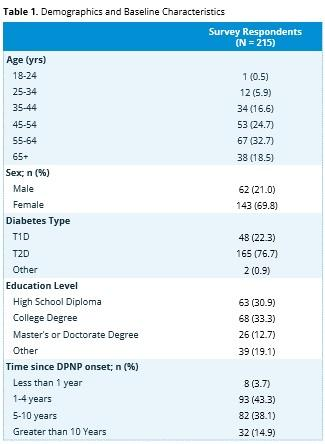
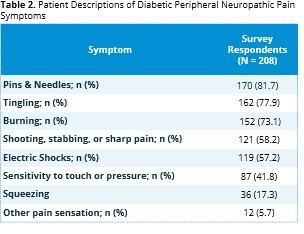
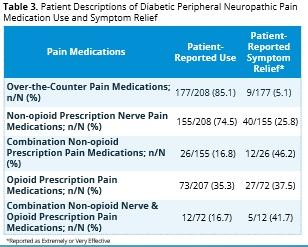
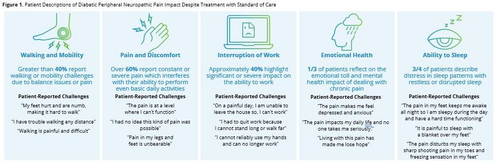
Two hundred fifty-three respondents took the survey and 38 were screened out. Of the 215 respondents surveyed, 66.5% were female, 76.7% had T2D, 22.3% had T1D, and 96.3% had DPNP symptoms for greater than 1 year. The most experienced DPNP symptoms were: (81.7%) pins/needles, (77.9%) tingling, (73.1%) burning pain, (58.1%) stabbing pain, (57.2%) electric-shock. DPNP symptoms significantly or severely impacted preforming normally daily activities and ability to continue to work in 39.9% and 44.2% of respondents, respectively. DPNP significantly or severely impacted sleep in 30.7% and 12.5% of patients. The majority of respondents (85%) reported use of an OTC pain reliever with 41.2% reporting daily use. Despite this OTC drug utilization, 43.5% reported OTC pain reliever efficacy as only somewhat effective and 42.9% reported not so effective. Many respondents (74.8%) reported use of pregabalin or gabapentin, with 72% reporting daily use. However, respondents reported its efficacy as somewhat effective (43.2%) and (22.6%) not so effective. Use of prescription opioid pain relievers to relieve DPNP symptoms was reported in 35.2 % of respondents. Daily or a few times a week frequency of prescription opioid pain reliever use was reported in 20.8% and 18.1%, respectively. Fifty percent of respondents reported the efficacy of prescription opioid pain reliever as somewhat effective. While 29.2% reported the efficacy of prescription opioid pain reliever as effective.
Conclusions
The presented patient-level survey analysis demonstrates the vast unmet medical need and profound disease burden faced by patients living with diabetic peripheral neuropathy pain. These DPNP symptoms negatively impacted normal daily activities, including the ability to work and sleep, in an overwhelming majority of respondents. Despite the use of available OTC, prescription non-opioid, and opioid pain relievers, a significant proportion of patients report limited symptom relief. These survey results lend to the existing literature highlighting a critical gap in effective DPNP management. The insights from this patient survey will guide the real-world patient needs in the design of the phase 3 pilavapadin clinical trial program.
Figures
References
Pop-Busui R, et al. Diabetic Neuropathy: A Position Statement by the American Diabetes Association. Diabetes Care 2017; 40:135-154
Preston F, et al. Painful Diabetic Peripheral Neuropathy: Practical Guidance and Challenges for Clinical Management. Diabetes, Metabolic Syndrome & Obesity 2023; 16:1595-1612
Preston F, et al. Painful Diabetic Peripheral Neuropathy: Practical Guidance and Challenges for Clinical Management. Diabetes, Metabolic Syndrome & Obesity 2023; 16:1595-1612
Conflicts of Interest
Pamela D. Price, PharmD
M. Belinda Hardin, PharmD
Tracy Newbold, PMP
Mark O’Neill
Suma Gopinathan, PhD
All are employees of Lexicon Pharmaceuticals
AC Staley, MBA, MS, IS – Employee of Medidata
M. Belinda Hardin, PharmD
Tracy Newbold, PMP
Mark O’Neill
Suma Gopinathan, PhD
All are employees of Lexicon Pharmaceuticals
AC Staley, MBA, MS, IS – Employee of Medidata
Funding Statement
Lexicon Pharmaceuticals